
PDF
NASA Gemini Program Files
Preliminary transcript of the Gemini GT-4 flight crew debriefing, Part II, prepared by NASA's Spacecraft Operations Branch in June 1965. It details systems operations, visual sightings, and experiments from the mission.
35 documents
Preliminary transcript of the Gemini GT-4 flight crew debriefing, Part II, prepared by NASA's Spacecraft Operations Branch in June 1965. It details systems operations, visual sightings, and experiments from the mission.
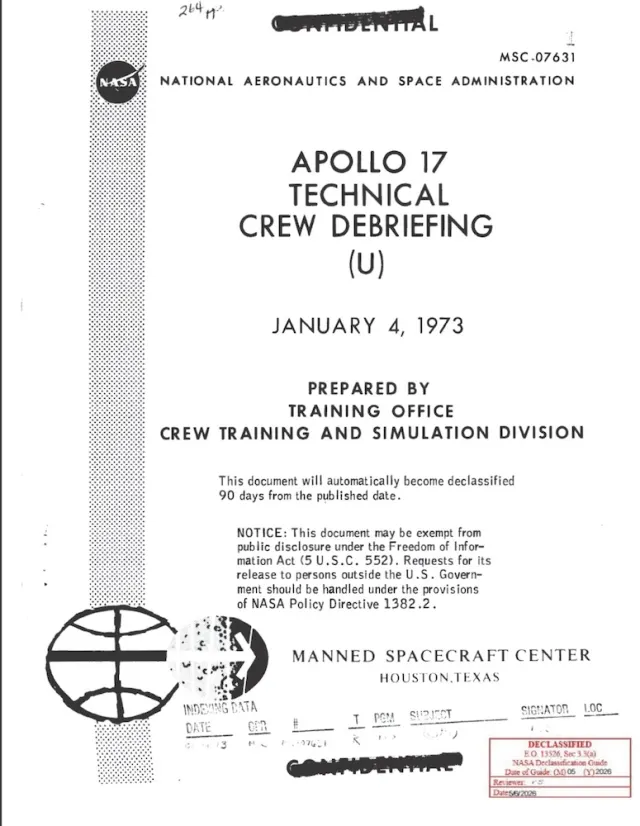
NASA technical debriefing for the Apollo 17 crew, dated January 4, 1973. Astronauts Evans, Cernan, and Schmitt discuss unusual sightings, including a 'fireball' and light flashes experienced during the mission and on the lunar surface.
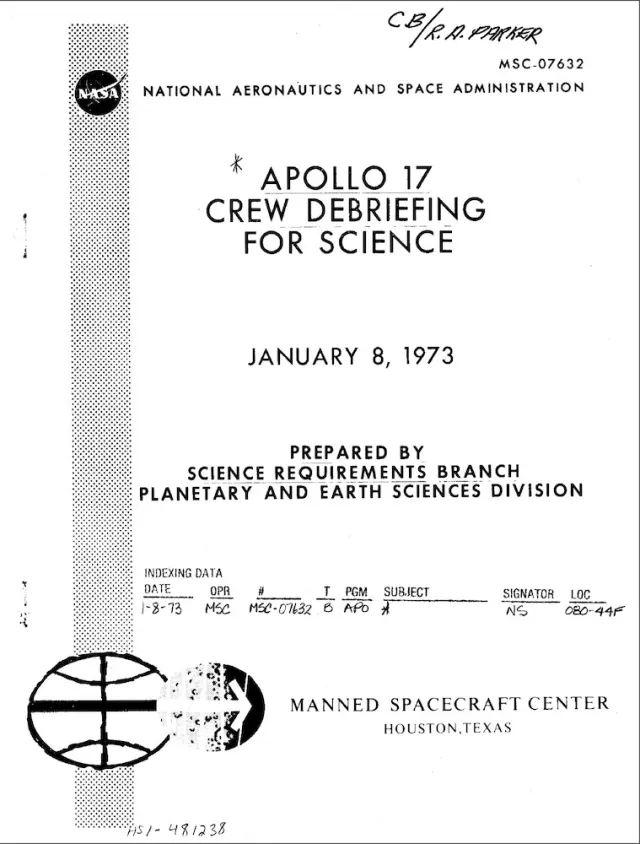
NASA report from January 8, 1973, documenting the Apollo 17 crew's science debriefing. It covers astronomical findings on ionized hydrogen, the Coma cluster, UV and X-ray backgrounds, and observations of Earth from space.
Gemini IV was the second crewed mission of the Gemini series. Astronauts James McDivitt and Edward White successfully completed the four-day flight between June 3 and June 7, 1965. The mission included the first American spacewalk. This collection of documents contains a transcription of the astronauts recounting their observations of bright particles outside the spacecraft, dated circa June 25, 1967, on pages 78-81, and page 101.
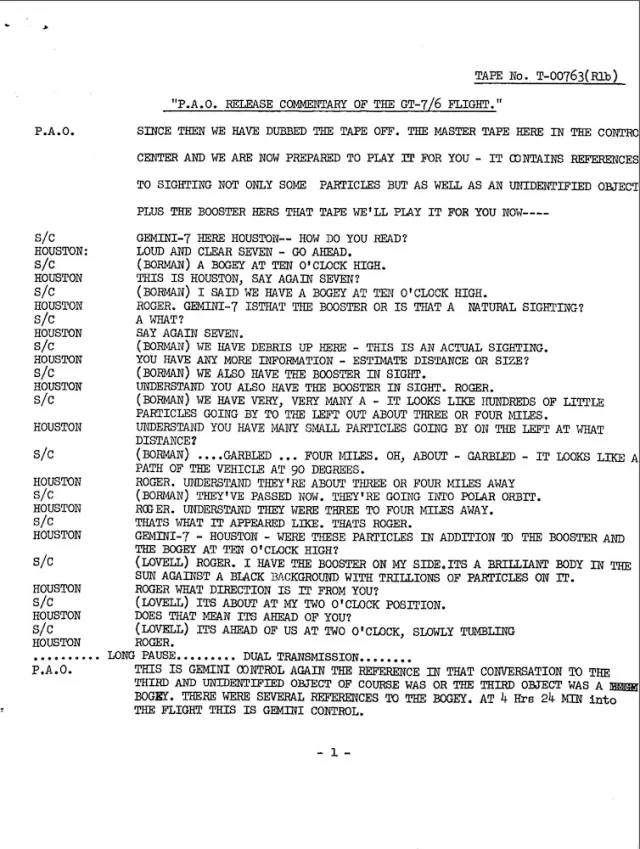
Transcript of NASA Gemini GT-7/6 mission audio where astronauts Borman and Lovell report an unidentified object ('bogey') and other debris to Houston Control. The document includes both a typed and a full handwritten version of the same communication.
Collection of NASA internal documents from 1966 concerning the Gemini IX mission debriefing. Includes typed and handwritten notes, memoranda, and routing slips detailing scientific experiments, astronaut observations, and operational feedback from the mission.
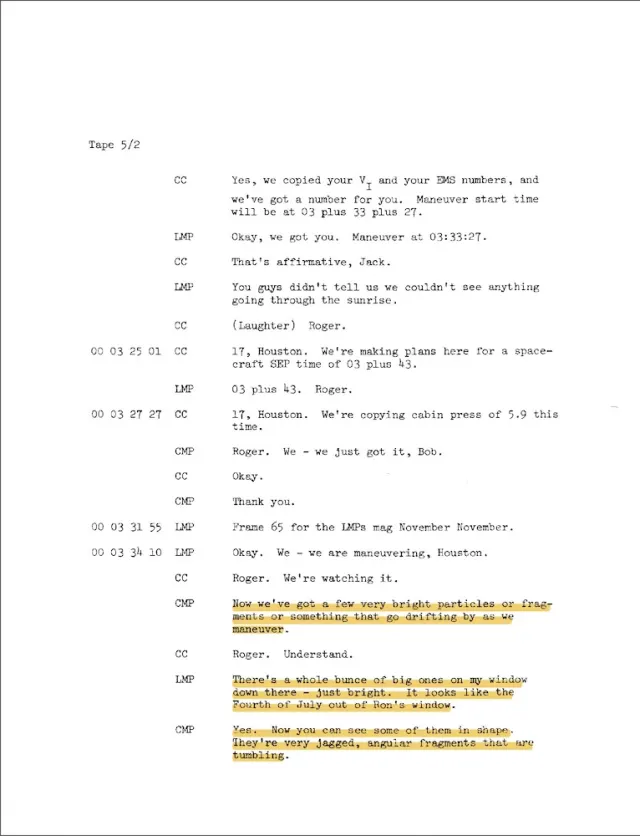
Transcript of Apollo 17 air-to-ground communications. Astronauts discuss observing bright, tumbling fragments later identified as the S-IVB stage, report on Earth weather patterns, and describe lunar surface features, including a flash on the surface.
Technical debriefing transcript for the NASA Gemini V (GT-5) mission, dated September 1965. The document details the flight crew's experiences with spacecraft systems, including platform alignment, OAMS thrusters, and control modes during the mission.
Excerpts from the NASA Apollo 11 Technical Crew Debriefing dated July 31, 1969. Astronauts Armstrong, Aldrin, and Collins discuss unusual visual sightings during the translunar coast, including an L-shaped object and flashes of light inside the cabin.
Preliminary transcript of the Gemini 4 (GT-4) flight crew debriefing, conducted aboard the USS Wasp on June 9, 1965. This document, Part I, covers the countdown, powered flight, and initial orbital phases of the mission, as recounted by the crew.
Technical debriefing transcript for the NASA Gemini VII mission, dated December 23, 1965. The document details the flight crew's experiences from countdown and powered flight through orbital operations, as recounted by astronauts Borman and Lovell.
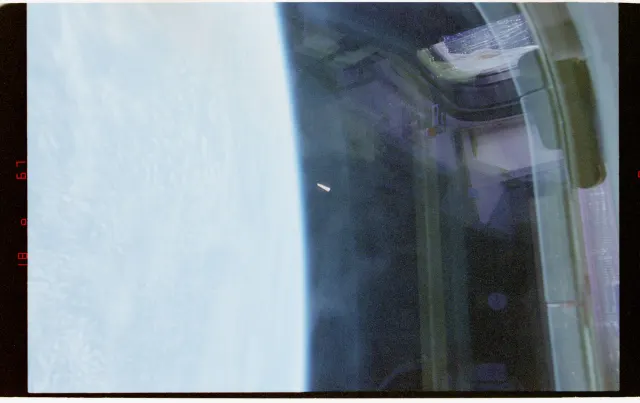
During STS-80, between November 19 and December 7, 1996, astronauts aboard Space Shuttle Columbia captured a series of three images of an unidentified object in low-Earth orbit. In the first photograph, the object is visible near the center of the frame, to the right of the limb of the Earth.
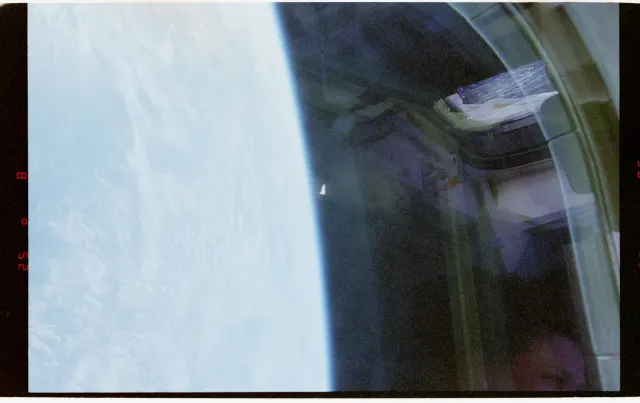
During STS-80, between November 19 and December 7, 1996, astronauts aboard Space Shuttle Columbia captured a series of three images of an unidentified object in low-Earth orbit. In the second photograph, the object is visible near the center of the frame, to the right of the limb of the Earth. It appears to have rotated or tumbled about its major axis, which is consistent with the behavior of a free-floating object.
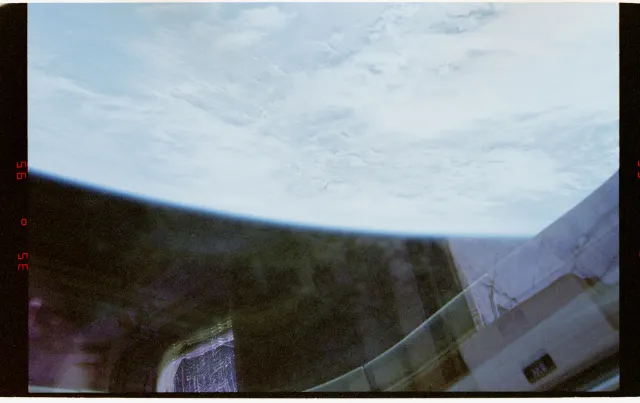
During STS-80, between November 19 and December 7, 1996, astronauts aboard Space Shuttle Columbia captured a series of three images of an unidentified object in low-Earth orbit. In the third photograph, the object is visible near the center of the frame, superimposed against the Earth. It appears to have continued along a trajectory passing between Columbia and the Earth.
This audio recording contains air to ground communications and the NASA Public Affairs audio feed with commentary, recorded during the flight of the Gemini 7 mission. In this excerpted segment of audio, Astronaut Frank Borman reports to NASA mission control in Houston his sighting of an unidentified object, which he referred to as a "bogey." This sighting occurred on December 5, 1965. The dialogue includes Borman's initial report, as well as additional comments by Astronaut Jim Lovell, Borman's fellow crew member.
During a medical debriefing of the crew of the Apollo 12 mission, Commander Charles “Pete” Conrad, Command Module Pilot Richard “Dick” F. Gordon, and Lunar Module Pilot Alan L. Bean describe their observations of instances of light flashes or “streaks of lights.” The astronauts each reported that these experiences occurred in the dark as they tried to sleep. The NASA medical team considered whether similar phenomena reported by Apollo 11 Lunar Module Pilot Buzz Aldrin had been attributable to exposure of the retina by cosmic rays. NASA later determined that the phenomena reported by the Apollo 12 flight crew were internal to the astronauts’ vision rather than external light sources.
During the eleventh and final crewed mission in the Apollo program, Apollo 17 Commander Gene Cernan, Lunar Module Pilot Harrison Schmitt, and Command Module Pilot Ronald Evans report seeing small lights outside the Apollo spacecraft during transit to the moon. The crew describe bright “particles” or “fragments” as being “jagged,” “angular,” and drifting near the Apollo spacecraft and the separated Saturn S-IVB stage. The Apollo 17 crew speculate that paint chips or ice chips are likely the source of these lights and note that they “twinkle” and move away from the Saturn S-IVB stage.
Approximately one hour and 41 minutes into the final and longest flight of Project Mercury, Mercury-Atlas 9 mission (MA-9) Faith 7 Pilot L. Gordon Cooper Jr. notes that he sees “John’s fireflies,” referring to John Glenn’s term from the Mercury-Atlas 6 mission. NASA later determined that the “fireflies” are attributable to frozen condensation separating from the spacecraft body. The white, green-hued appearance of this phenomenon results from sunlight reflecting off frozen condensation.
During the final and longest flight of Project Mercury, Mercury-Atlas 9 mission (MA-9) Faith 7 Pilot L. Gordon Cooper Jr. describes the brilliant blue of sunrise beneath the haze layer of the Earth’s atmosphere. As he approaches sunrise, he describes small, luminous, brilliant white particles drifting away from the spacecraft. Cooper describes observing “fireflies” after deploying beacons, which are spherical mission-related equipment with xenon strobe lights.
During the Mercury Atlas 8 mission, Sigma 7 pilot Walter M. “Wally” Schirra Jr. describes observing “little white objects that tend to come from the capsule itself and drift off.” Schirra later also refers to those objects as “particles” and “lathe shavings.” Schirra also describes seeing a burst of light in the window, whose source he cannot identify. He speculates that his observation corresponds with the moment the sun passes below the horizon during sunset.
During the fourth crewed spaceflight and second orbital flight of Project Mercury, Mercury-Atlas 7 (MA-7), Aurora 7 pilot Scott Carpenter describes white particles in view that appear to move at “random” and “look exactly like snowflakes.” He describes these phenomena as reflective, and that some seemed to move faster than the Aurora 7 spacecraft.
During the recovery of the fourth launch and second crewed spaceflight of Project Mercury, Mercury-Redstone 4 (MR-4) Liberty Bell 7, the recovery team discusses a dye pack in the water that did not activate.
In November 1962, journalist Walter Cronkite interviewed astronaut Gordon Cooper. In this excerpt from that interview, Cronkite asks Cooper about his views regarding the nature of unidentified flying objects, having previously expressed an interest in the subject. Cooper opines that “a large number of exceptionally well-qualified people have seen objects” without a “logical explanation” and speculates on the existence of other planets with “a livable atmosphere” and that maybe there are “some type of human life” out there. Interview was conducted in November 1962.
This debriefing includes presentations from principal investigators of various Apollo experiments. The principal investigators describe preliminary results of their work to educate the Apollo crews about what they’ve obtained from Apollo 16 to help prepare for Apollo 17. They also describe anomalies, such as a “flash” that was observed that had not yet been reported. The flash is mentioned beginning at 25:15.
At 32:41, the speaker makes an off-handed comment, “Could be an alien starbase or something, I don’t know” when discussing correlations between experimental data sets.
This file contains segment 1 of 2 of the Apollo 14 post-mission crew debriefing at the Manned Spacecraft Center (now Johnson Space Center), Houston, Texas. In the recording, crew members and debriefers discuss the “light flash phenomena,” a then novel, now well-documented biological effect where high-energy cosmic rays pass through the eye and strike the retina, causing the perception of light streaks or flashes. The questioners attempt to distinguish the characteristics of the observed phenomena. The debriefing continues in the next file (NASA-UAP-D027), which contains some overlapping audio content.
This file contains segment 2 of 2 of the Apollo 14 post-mission crew debriefing at the Manned Spacecraft Center (now Johnson Space Center), Houston, Texas. In this continued segment, crew members and debriefers further discuss the “light flash phenomena,” a then novel, now well-documented biological effect where high-energy cosmic rays pass through the eye and strike the retina, causing the perception of light streaks or flashes.
This file contains segment 1 of 2 of the Apollo 17 post-mission medical debriefing at the Manned Spacecraft Center (now Johnson Space Center), Houston, Texas. In the recording, crew members discuss the “light flash phenomena,” a then novel, now well-documented biological effect where high-energy cosmic rays pass through the eye and strike the retina, causing the perception of light streaks or flashes. Two of the three crew members reported observing these flashes at various points during the mission, including in lunar orbit and while on the lunar surface. The debriefing continues in the next file (NASA-UAP-D029).
This file contains segment 2 of 2 of the Apollo 17 post-mission medical debriefing at the Manned Spacecraft Center (now Johnson Space Center), Houston, Texas. In this continued segment, crew members and debriefers further discuss the “light flash phenomena,” a then novel, now well-documented biological effect where high-energy cosmic rays pass through the eye and strike the retina, causing the perception of light streaks or flashes. Two of the three crew members reported observing these flashes at various points during the mission, including in lunar orbit and while on the lunar surface.
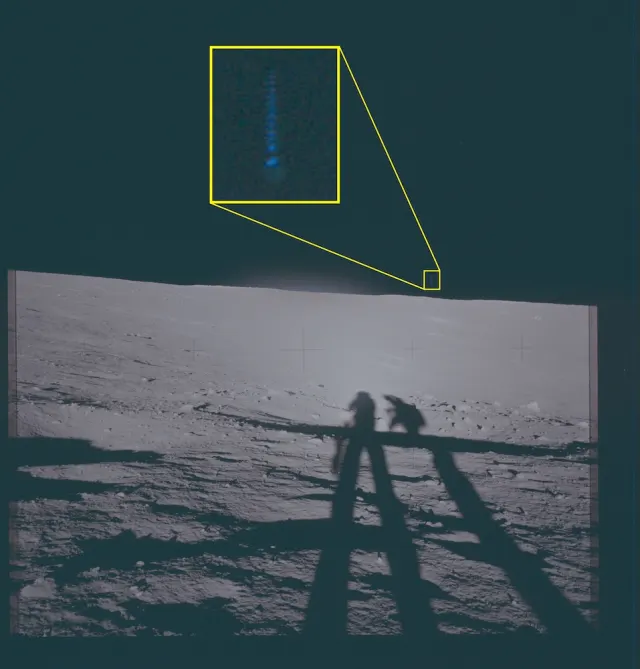
This archival photograph depicts the lunar surface as viewed from the landing site of Apollo 12. This image features a highlighted area of interest slightly to the right of the vertical axis of the frame, above the horizon, in which unidentified phenomena are visible. This image has been modified from its original state to assist viewers in identifying specific areas of interest. These highlights are provided for contextual purposes only. Such alterations do not constitute an analytical judgment, investigative conclusion, or factual determination regarding the nature or significance of the subject matter.
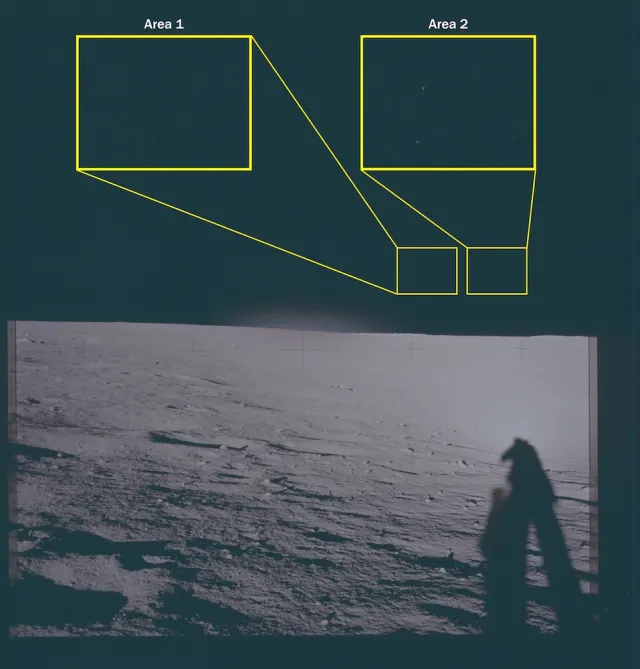
This archival photograph depicts the lunar surface as viewed from the landing site of Apollo 12. This image features two highlighted areas of interest, labeled “Area 1” and “Area 2,” slightly to the right of the vertical axis of the frame, above the horizon, in which unidentified phenomena are visible. This image has been modified from its original state to assist viewers in identifying specific areas of interest. These highlights are provided for contextual purposes only. Such alterations do not constitute an analytical judgment, investigative conclusion, or factual determination regarding the nature or significance of the subject matter.
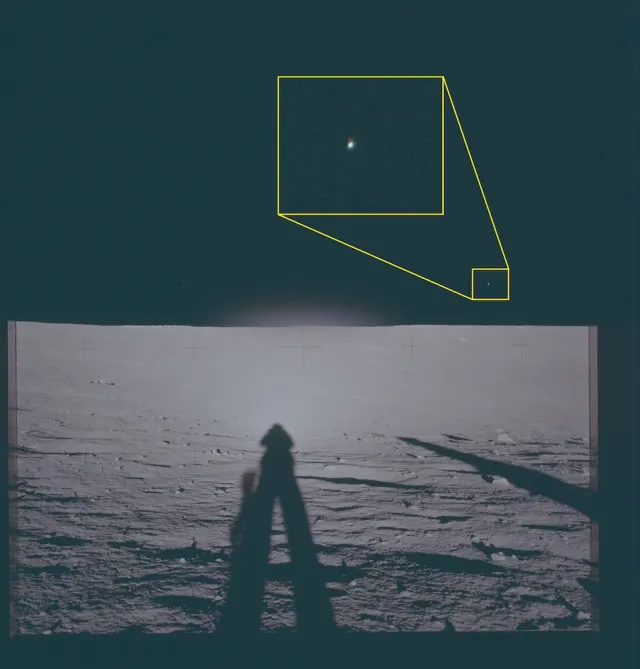
This archival photograph depicts the lunar surface as viewed from the landing site of Apollo 12. This image features a highlighted area of interest near the right edge of the frame, above the horizon, in which unidentified phenomena are visible. This image has been modified from its original state to assist viewers in identifying specific areas of interest. These highlights are provided for contextual purposes only. Such alterations do not constitute an analytical judgment, investigative conclusion, or factual determination regarding the nature or significance of the subject matter.
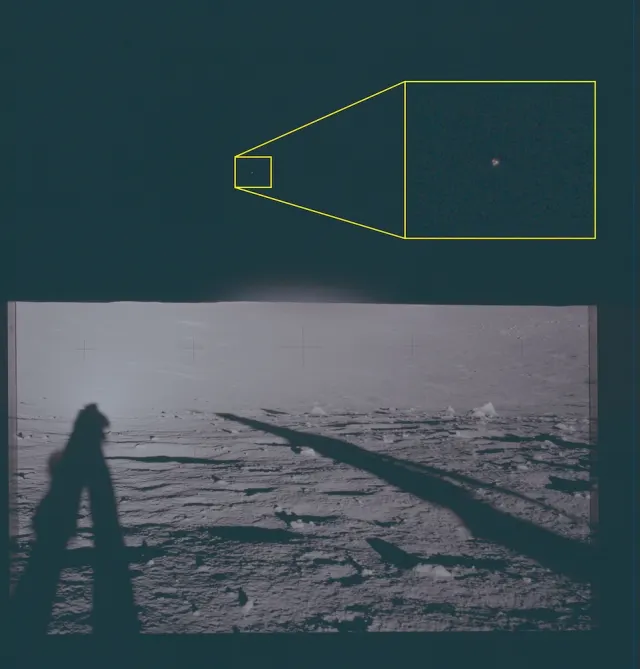
This archival photograph depicts the lunar surface as viewed from the landing site of Apollo 12. This image features a highlighted area of interest slightly to the left of the vertical axis of the frame, above the horizon, in which unidentified phenomena are visible. This image has been modified from its original state to assist viewers in identifying specific areas of interest. These highlights are provided for contextual purposes only. Such alterations do not constitute an analytical judgment, investigative conclusion, or factual determination regarding the nature or significance of the subject matter.
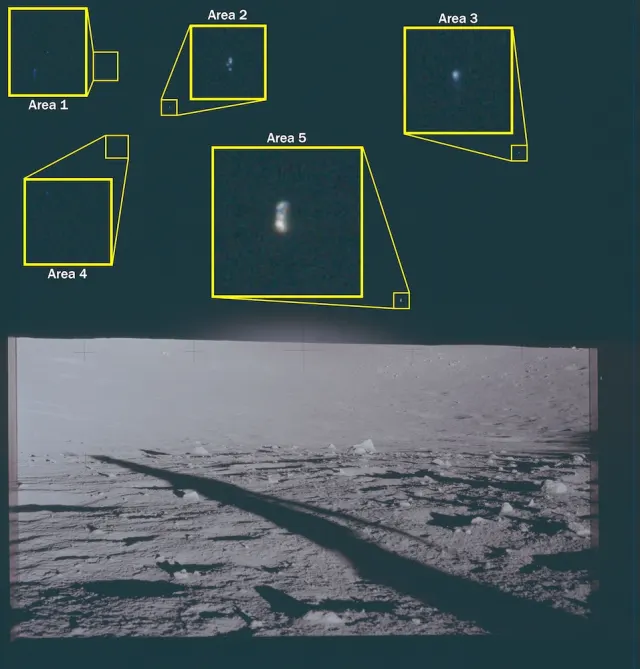
This archival photograph depicts the lunar surface as viewed from the landing site of Apollo 12. This image features five highlighted areas of interest, labeled “Area 1” through “Area 5,” above the horizon, in which unidentified phenomena are visible. This image has been modified from its original state to assist viewers in identifying specific areas of interest. These highlights are provided for contextual purposes only. Such alterations do not constitute an analytical judgment, investigative conclusion, or factual determination regarding the nature or significance of the subject matter.
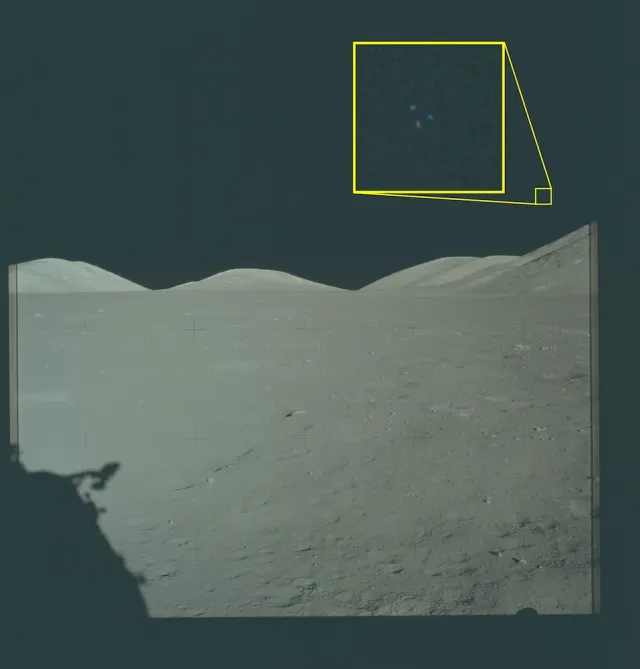
As part of the review of historical UAP materials under PURSUE, DOW has opened a case to investigate the accompanying NASA photograph from the Apollo 17 mission, taken December 1972. The image contains three “dots” in a triangular formation in the lower right quadrant of the lunar sky that is clearly visible upon magnification of the image. While this photo has been previously released and discussed by keen observers, there is no consensus about the nature of the anomaly. New preliminary US government analysis suggests the image feature is potentially the result of a physical object in the scene. Additionally, as part of this investigation, the government has obtained the original film from the Apollo 17 mission and the results of the full NASA and DOW analysis will be released when completed.